API Reference
HidTen: A framework for combining hidden Markov models with modern deep learning.
This page provides a complete reference to all public classes, functions, and modules in HidTen.
Core Module
The main hidten module exports the primary classes and functions.
HMM Classes
Core HMM implementation with configuration and modes.
- class hidten.hmm.HMM
Bases:
Generic[T_Tensor]A modular hidden Markov model (HMM).
- add_emitter(emitter, observations=None)
Adds an emitter to the HMM.
- Parameters:
emitter (Emitter) – The emitter to add.
observations (tuple[int, ...], optional) – A tuple of indices specifying which observations the emitter receives. If not specified, the emitter receives the next observation that is currently unused by any other emitter.
- Return type:
None
- emission_scores(*observations)
Computes the joint emission scores for all emitters.
- Parameters:
observations (Tensor or tuple of Tensors) – The input sequence(s). Tensor i should be broadcastable to shape
(B, T, H, D_i)whereBis the batch size,Tis the time dimension,His the number of HMM heads andD_iis the feature dimension. It is possible to also supply a tensor of shape(B, T, D), if all heads should receive the same input.- Returns:
The joint emission scores of shape
(B, T, H, Q).- Return type:
Tensor
- abstractmethod joint_log_prob(*observations, states)
Computes the joint log-probability of the observations
oand the statesx, i.e.P(o, x).- Parameters:
observations (Tensor or tuple of Tensors) – The input sequence(s). Tensor i should be broadcastable to shape
(B, T, H, D_i)whereBis the batch size,Tis the time dimension,His the number of HMM moheadsdels andD_iis the feature dimension.states (Tensor) – The hidden state indices of shape
(B, T, H).
- Returns:
The joint log-probability of the observations and the states of shape
(B, H).- Return type:
Tensor
- observations_per_emitter: List[Tuple[int, ...]] | None = None
An optional datastructure that specifies for each emitter which observations it receives. If not specified, each emitter receives the next unused observation in the order they were added to the HMM.
- prior_scores()
Calculates the prior scores for the HMM.
- Returns:
The prior scores of shape
(H), whereHis the number of heads.- Return type:
Tensor
- abstractmethod sample(B, T)
Samples a number of tensors from the HMM by repeatedly sampling states based on possible state transitions and afterward sampling possbile emissions from these states.
- Parameters:
B (int) – Number of sequences to sample.
T (int) – Number of time steps to sample.
- Returns:
State tensor of shape
(B, T, H, Q)and emission tensors (as many as emitters in the HMM) of shape(B, T, H, D), whereQis the number of states andDis the size of the emission alphabet.- Return type:
tuple[tf.Tensor, tuple[tf.Tensor, ...]]
- property transitioner: Transitioner[T_Tensor]
- use_padding()
Returns true if the HMM support variable length inputs.
- Return type:
bool
- class hidten.hmm.HMMConfig(*, states, heads=None, max_states=None)
Bases:
ModelConfigThe basic configuration for any HMM.
- Parameters:
states (Sequence[int])
heads (int)
max_states (int)
- heads: int
Number of heads in the HMM. If not specified, can be inferred by the length of
states. Defaults to 1.
- max_states: int
Maximal number of states across all HMM heads.
- model_config = {'frozen': True}
Configuration for the model, should be a dictionary conforming to [ConfigDict][pydantic.config.ConfigDict].
- states: Sequence[int]
The number of states in each head of the HMM. Can also be given as a single integer and is automatically expanded to the given number of heads.
- classmethod validate_config(values)
- class hidten.hmm.HMMMode(*values)
Bases:
EnumCollection of modes for an HMM. Changing the mode leads to a different behaviour when calling an
hidten.HMMas a function by__call__.- BACKWARD_LOG = 2
Enables calculation of the logarithmic backward variables.
- EMISSION_SCORES = 7
Only outputs the scores of the given emissions without utilizing any transitions of the model.
- FORWARD_LOG = 0
Enables calculation of the logarithmic forward variables.
- FORWARD_SCALED = 1
Enables calculation of the scaled forward variables.
- LIKELIHOOD_LOG = 3
Enables calculation of the log-likelihood.
- MEA = 6
Enables calculation of MEA state sequences.
- POSTERIOR = 4
Enables calculation of posterior state distributions.
- VITERBI = 5
Enables calculation of Viterbi state sequences.
Configuration
Base configuration classes and decorators for model setup.
- class hidten.config.ModelConfig
Bases:
BaseModelA base model configuration class that new config classes should inherit from. A method
self.validate_configcan be defined where value errors can be thrown or fields can be updated.- model_config = {}
Configuration for the model, should be a dictionary conforming to [ConfigDict][pydantic.config.ConfigDict].
- hidten.config.with_config(config_class, overwrite_init=False)
Decorator for any class that requires a number of simple configuration attributes. Expects the decorated class to have a
ModelConfigobject of nameconfig. Adds methodsfrom_configandget_configto the class, as well as an attributeconfig_clsthat is the type of the given config.Example use case: ```python class MyClassConfig(ModelConfig):
n: int p: float
@with_config(MyClassConfig) class MyClass:
- Parameters:
config_class (type) – Class that inherits from
ModelConfig.overwrite_init (bool, optional) – If set to True, overwrites the
__init__method of the decorated class to automatically create theself.configattribute. A new method calledself.post_config_initcan be implemented that is called at the end of the overwritten__init__. Defaults to manual__init__implementation.
- Return type:
Callable[[type[T_Model]], type[T_Model]]
Emitters
Emission models that map observations to feature values.
- class hidten.emitter.Emitter
Bases:
Module[T_Tensor]The Emitter base class.
An emitter is a module that maps sequences of observations to feature values. The feature values decribe how likely each observation is to be emitted by each hidden state.
- property clip_max: float
Clips the calculated emission scores to the given maximum.
- property clip_min: float
Clips the calculated emission scores to the given minimum.
- abstractmethod emission_scores(observations)
Computes how likely each observation is emitted by any hidden state.
- Parameters:
observations (Tensor) – The observation sequences of shape
(B, T, D)or(B, T, H, D), whereDis the size of the emission alphabet.- Returns:
- A state tensor of shape
(B, T, H, Q), where Qis the number of hidden states.
- A state tensor of shape
- Return type:
Tensor
- abstractmethod matrix()
Calculates the emission matrix based on parameters of this class.
- Returns:
- The emission matrix of shape
(H, Q, K)where His the number of heads,Qis the number of hidden states andKis thematrix_dim.
- The emission matrix of shape
- Return type:
Tensor
- abstractmethod sample(state)
Samples a possible emission given the current state.
- Parameters:
state (Tensor) – Tensor of shape
(B, H, Q), whereBis a batch dimension,His the number of heads of the HMM andQis the number of states.- Returns:
Emission tensor of shape
(B, H, Q).- Return type:
Tensor
- abstractmethod state_emissions(states)
Computes how likely any observation is emitted by the given hidden states.
- Parameters:
states (Tensor) – The input state sequences of shape
(B, T, H, Q), whereQis the number of hidden states.- Returns:
- The emission distributions of shape
(B, T, H, D), whereDis the size of the emission alphabet.
- Return type:
Tensor
- class hidten.emitter.PaddingEmitter
Bases:
Emitter[T_Tensor]A specialized emitter to handle padding tracks. Adding this emitter makes an HMM support variable-length sequences. Accepts padding as a binary input track where “true” or “1” indicates a non-padded position that should be used in calculations.
- property allow: ndarray
Not supported for PaddingEmitter.
- abstractmethod emission_scores(observations)
Returns emission scores with the following scheme:
input 0 | input 1
- —————————|——————–
padding emission state | 1 | 0 all other states | 0 | 1
- Parameters:
observations (Tensor) – The observation sequences of shape
(B, T, D)or(B, T, H, D), whereDis the size of the emission alphabet.- Returns:
- A state tensor of shape
(B, T, H, Q), where Qis the number of hidden states including an internal, appended padding emission state.
- A state tensor of shape
- Return type:
Tensor
Not supported for PaddingEmitter.
Transitioners
Transition models that handle state-to-state transitions.
- class hidten.transitioner.TransitionMode(*values)
Bases:
IntFlagCollection of modes for the transitioner step.
- ALLOWED = 8
Instead of the regular transition matrix, uses a matrix that contains ones for allowed transitions and zeros otherwise.
- LOG_SUM_EXP = 2
Calculates the log-sum-exp over the latent states.
- MAX = 4
Computes the maximum over the latent states.
- REVERSE = 16
Computes steps in reverse order.
- SUM = 1
Sums over the latent states.
- class hidten.transitioner.Transitioner
Bases:
Module[T_Tensor]The Transitioner base class.
A transitioner is a module that implements a discrete time step of a Markov chain for a given number of heads. The state graph of each head can be restricted in the number of states and the allowed transitions between states.
- property allow_start: ndarray
Restrict the starting distribution by only allowing the given states. If this method is not called before the model is built, all states are allowed.
- Returns:
- Array of pairs
(h, i), where iis an allowed starting state for headh. If only tuples of one index(i, )or integersiare given, they are assumed to be true in each head.
- Array of pairs
- Return type:
indices (np.ndarray)
- abstractmethod matrix(transition_delta=None)
Computes the state transition matrices for each model.
- Parameters:
transition_delta (Tensor or None, optional) – Time-varying change that is added on top of the transitioner kernel. Should be of shape
(B, T, K)or broadcastable to it, whereKis the kernel size of transitioner (seetransitioner.kernel.shape).- Returns:
- The state transition probabilities of shape
(H, Q, Q)(or(B, T, H, Q, Q)if transition_delta is provided).
- Return type:
Tensor
- property mode: TransitionMode
- prior_scores()
Calculates the prior scores for the modules’ parameters in log-scale.
- Returns:
- The prior scores of shape
(H), whereH is the number of heads.
- The prior scores of shape
- Return type:
Tensor
- abstractmethod sample(state=None)
Samples a possible next state given the previous.
- Parameters:
state (Tensor, optional) – Tensor of shape
(B, H, Q), whereBis a batch dimension,His the number of heads of the HMM andQis the number of states. If no state is supplied, the Transitioner uses the start distribution withB=1.- Returns:
Next state tensor of shape
(B, H, Q).- Return type:
Tensor
Allows to share parameters of the start distribution.
- Parameters:
indices (list of ranges or indices) – A sequence of index pairs
(a,b)whereaandbare indices of the tuples inTransitioner.allow_start. It has to be of the same length as the initial values given for the start distribution. Alternatively, it can be a list of indices of the same length asallow_start. These indices are then used to mark which value in the given initial values will be used.
- abstractmethod start_dist()
Computes the initial distribution for each model.
- Returns:
The start distributions of shape
(H, Q).- Return type:
Tensor
- abstractmethod step(x, t=None)
Performs a single time step of the Markov chain.
- Parameters:
x (Tensor) – The input tensor of shape
(H, B, Q).Bis the batch size,His the number of heads andQis the number of states.t (int, optional) – The time step index. This is only needed for transitioners that use transition deltas.
- Returns:
The output tensor of shape
(H, B, Q).- Return type:
Tensor
Priors
Prior distributions for model parameters.
- class hidten.prior.Prior
Bases:
Module[T_Tensor]The prior base class.
A prior is a module takes as input a tensor of shape (…, Q, K), where Q is the number of hidden states and K is a kernel size - representing the parameters of another module. The prior rates this parameter set, usually in a probabilistic way, and returns prior_scores that rate how likely the parameters are.
- abstractmethod prior_scores(values)
Computes prior scores for the input values.
- Parameters:
values (Tensor) – The input values of shape
(H, Q, D), whereDis the prior feature dimension.- Returns:
- The prior scores of shape
(H)with prior scores for each head summed over the states.
- Return type:
Tensor
Generic Base Classes
Abstract base classes for modules and distributions.
- class hidten.generic.Module
Bases:
Generic[T_Tensor]Base class for all modules in the HMM framework.
- __call__(*observations)
Calls the module with the given observations and returns the result.
- Parameters:
observations (Tensor or tuple of Tensors) – The input sequence(s). Each tensor i should be broadcastable to the shape
(N_1, .., N_k, D_{in}^{(i)}), i.e. they agree on all dimensions except for the last dimensionD_{in}^{(i)}, the individual feature dimensions.- Returns:
Output of shape
(N_1, .., N_k, D_{out}).- Return type:
Tensor
- property allow: ndarray
Restrict the matrix of the module by only allowing a subset of the matrix entries to be modeled. If this method is not called before the model is built, a dense matrix is modeled (everything allowed).
- Returns:
- Array of triplets
(h, i, j), where
(i, j)is an allowed matrix entry of stateito columnjfor some head indexh. For emitters,jrefers to an symbol in the emission alphabet, for transitionersjrefers to another state. If pairs(i, j)are given, they are assumed to be the same for all available heads. Therefore, they are internally expanded to triplets. The order of indices given remains throughout the Module. If an initializer is specified, values in this intializer always correspond to the (possibly automatically) expanded triplets.
- Array of triplets
- Return type:
indices (np.ndarray)
- property heads: int
The number of heads in the HMM configuration.
- abstractmethod matrix()
Calculates a matrix based on a parameter kernel for this module. This could be a transition matrix or a matrix describing emission distributions.
- Returns:
- The emission matrix of shape
(H, Q, R)where His the number of heads,Qis the number of hidden states andRis a feature dimension.
- The emission matrix of shape
- Return type:
Tensor
- property max_states: int
The maximum number of states across all heads.
- prior_scores()
Calculates the prior scores for the modules’ parameters in log-scale.
- Returns:
- The prior scores of shape
(H), whereH is the number of heads.
- The prior scores of shape
- Return type:
Tensor
Defines if some parameters of the module are shared among different states.
- Parameters:
indices (list of ranges or list of indices or array of indices) – A sequence of index pairs
(a,b)whereaandbare indices of the tuples inallow. It has to be of the same length as the initial values given for the kernel. Alternatively, it can be a list of indices of the same length asallow. These indices are then used to mark which value in the given initial values will be used.- Returns:
- Array of indices of the same length as
allow, where indices insharemark which values in the parameter kernel are shared.
- Return type:
share (np.ndarray)
- property states: list[int]
The number of states for each head.
Utilities
Utility functions and helper classes.
- hidten.util.expand_indices(indices, inner_length, max_head, max_index=None)
Expands tuples in a given list to the given
inner_length. All tuples should be ofinner_lengthorinner_length-1. Shorter tuples(i_1, ..., i_p)are expanded to(j, i_1, ..., i_p), wherej=1, ..., max_head. They are expanded in their original position, shifting later specified tuples by a number ofmax_head-1.- Parameters:
indices (sequence of sequence of int) – The sequence of tuples of integers to expand. The inner sequence can also be an integer, which is internally replaced by a tuple of length one.
inner_length (int) – Target length of the given tuples.
max_head (int) – Maximal first index in the tuples.
max_index (list[int | list[int]], optional) – List of maximal possible indices
(i_1, ..., i_p)to use over different headsj. If the maximal indices are lists themselves, they are understood per-axes. For example,max_index=[(3, 5), (2, 3)]are maximal indices for two heads, in which the first head has a tensor of shape(3, 5). Defaults to no index checking.
- Return type:
list[tuple[int, …]]
Converts a given representation of shared parameters to the internally used representation.
- Parameters:
share (list of ranges or indices) – If a list of indices is given, it is left unchanged. For a given list of ranges
(a,b), the method returns a list of ascending indices of lengthNwhere the indices inlist[a:b]are the same.N (int) – Size of the resulting list, which is equal to the number of virtual parameters. With shared parameters, this is larger than the actual number of parameters.
- Return type:
list[int]
- hidten.util.validate_indices(indices)
Validates the indices. Valid indices are those such that all states have at least one outgoing edge in each head and there are no multi-edges between states of the same head.
- Parameters:
indices (list of triplets) – List of triplets
(h, i, j), where(i, j)is an allowed connection between statesiandjfor some head indexmof the HMM.- Return type:
None
TensorFlow Backend
The TensorFlow backend provides concrete implementations optimized for TensorFlow.
Core TensorFlow HMM
Main TensorFlow implementation of HMM.
- class hidten.tf.hmm.TFHMM(*args, **kwargs)
Bases:
Layer,HMM[Tensor],TFViterbiMixin,TFForwardBackwardMixinThe basic configuration for any HMM.
- build(input_shape)
- Parameters:
input_shape (TensorShape | tuple[int | None, ...] | tuple[tuple[int | None, ...], ...])
- Return type:
None
- call(*observations, transition_delta=None, mode=HMMMode.FORWARD_LOG, parallel=1, output_dtype=tf.int32)
Calls the layer with an operation defined by its call mode.
- Parameters:
observations (Tensor or tuple of Tensors) – The input sequence(s). Tensor i should be broadcastable to shape
(B, T, H, D_i)whereBis the batch size,Tis the time dimension,His the number of HMM heads andD_iis the feature dimension.transition_delta (Tensor or None, optional) – Time-varying change that is added on top of the transitioner kernel. Should be of shape
(B, T-1, K)or broadcastable to it, whereKis the kernel size of transitioner (seetransitioner.kernel.shape).mode (HMMMode) – The call mode of the HMM. Defaults to
HMMMode.FORWARD_LOG.parallel (int) – The parallel factor for the HMM. This is equal to the number of sequence chunks that are processed in parallel. Defaults to 1.
output_dtype (tf.dtypes.DType, optional) – The output dtype for Viterbi and MEA modes. Defaults to tf.int32.
- Returns:
- A tensor which shape depends on the call mode of
the HMM (see TFForwardBackwardMixin and TFViterbiMixin).
- Return type:
Tensor
- classmethod from_config(config, custom_objects=None)
Initializes and returns an object of this class with the given configuration dictionary.
- Parameters:
config (dict[str, Any])
custom_objects (None)
- Return type:
T_Model
- get_config()
Returns the config used in the class as a dictionary.
- Return type:
dict[str, Any]
- joint_log_prob(*observations, states)
Computes the joint log-probability of the observations
oand the statesx, i.e.P(o, x).- Parameters:
observations (Tensor or tuple of Tensors) – The input sequence(s). Tensor i should be broadcastable to shape
(B, T, H, D_i)whereBis the batch size,Tis the time dimension,His the number of HMM moheadsdels andD_iis the feature dimension.states (Tensor) – The hidden state indices of shape
(B, T, H).
- Returns:
The joint log-probability of the observations and the states of shape
(B, H).- Return type:
Tensor
- sample(B, T)
Samples a number of tensors from the HMM by repeatedly sampling states based on possible state transitions and afterward sampling possbile emissions from these states.
- Parameters:
B (int) – Number of sequences to sample.
T (int) – Number of time steps to sample.
- Returns:
State tensor of shape
(B, T, H, Q)and emission tensors (as many as emitters in the HMM) of shape(B, T, H, D), whereQis the number of states andDis the size of the emission alphabet.- Return type:
tuple[tf.Tensor, tuple[tf.Tensor, ...]]
- property transitioner: TFTransitioner
TensorFlow Emitters
TensorFlow-specific emission models.
- class hidten.tf.emitter.base.TFEmitter(*args, **kwargs)
Bases:
TFLayer,Emitter[Tensor]Base class for TF emitters.
- call(emissions, use_padding=False)
- Parameters:
emissions (Tensor)
use_padding (bool)
- Return type:
Tensor
- class hidten.tf.emitter.base.TFPaddingEmitter(*args, **kwargs)
Bases:
Layer,PaddingEmitter[Tensor]TensorFlow implementation of the PaddingEmitter.
- call(emissions, use_padding=False)
- Parameters:
emissions (Tensor)
use_padding (bool)
- Return type:
Tensor
- emission_scores(observations)
Returns emission scores with the following scheme:
input 0 | input 1
- —————————|——————–
padding emission state | 1 | 0 all other states | 0 | 1
- Parameters:
observations (Tensor) – The observation sequences of shape
(B, T, D)or(B, T, H, D), whereDis the size of the emission alphabet.- Returns:
- A state tensor of shape
(B, T, H, Q), where Qis the number of hidden states including an internal, appended padding emission state.
- A state tensor of shape
- Return type:
Tensor
- matrix()
Calculates the emission matrix based on parameters of this class.
- Returns:
- The emission matrix of shape
(H, Q, K)where His the number of heads,Qis the number of hidden states andKis thematrix_dim.
- The emission matrix of shape
- Return type:
Tensor
- class hidten.tf.emitter.categorical.TFCategoricalEmitter(*args, **kwargs)
Bases:
TFEmitterAn emitter for categorical observations.
- build(input_shape)
- Parameters:
input_shape (TensorShape | tuple[int | None, ...] | tuple[tuple[int | None, ...], ...])
- Return type:
None
- emission_scores(observations)
Computes how likely each observation is emitted by any hidden state.
- Parameters:
observations (Tensor) – The observation sequences of shape
(B, T, D)or(B, T, H, D), whereDis the size of the emission alphabet.- Returns:
- A state tensor of shape
(B, T, H, Q), where Qis the number of hidden states.
- A state tensor of shape
- Return type:
Tensor
- matrix()
Calculates the emission matrix based on parameters of this class.
- Returns:
- The emission matrix of shape
(H, Q, K)where His the number of heads,Qis the number of hidden states andKis thematrix_dim.
- The emission matrix of shape
- Return type:
Tensor
- sample(state)
Samples a possible emission given the current state.
- Parameters:
state (Tensor) – Tensor of shape
(B, H, Q), whereBis a batch dimension,His the number of heads of the HMM andQis the number of states.- Returns:
Emission tensor of shape
(B, H, Q).- Return type:
Tensor
- state_emissions(states)
Computes how likely any observation is emitted by the given hidden states.
- Parameters:
states (Tensor) – The input state sequences of shape
(B, T, H, Q), whereQis the number of hidden states.- Returns:
- The emission distributions of shape
(B, T, H, D), whereDis the size of the emission alphabet.
- Return type:
Tensor
- class hidten.tf.emitter.multivariate_normal.TFMVNormalEmitter(*args, **kwargs)
Bases:
TFEmitterAn emitter for multivariate normal distributed observations. The configuration for a multivariate normal emitter.
- activation_overridable: bool = False
Whether users may override the activation pair of this module.
- build(input_shape)
- Parameters:
input_shape (TensorShape | tuple[int | None, ...] | tuple[tuple[int | None, ...], ...])
- Return type:
None
- default_activation: Callable | None = None
The activation used when none is set explicitly.
- default_inverse_activation: Callable | None = None
The inverse activation used when none is set explicitly.
- emission_scores(observations)
Computes how likely each observation is emitted by any hidden state.
- Parameters:
observations (Tensor) – The observation sequences of shape
(B, T, D)or(B, T, H, D), whereDis the size of the emission alphabet.- Returns:
- A state tensor of shape
(B, T, H, Q), where Qis the number of hidden states.
- A state tensor of shape
- Return type:
Tensor
- classmethod from_config(config, custom_objects=None)
Initializes and returns an object of this class with the given configuration dictionary.
- Parameters:
config (dict[str, Any])
custom_objects (None)
- Return type:
T_Model
- get_config()
Returns the config used in the class as a dictionary.
- Return type:
dict[str, Any]
- get_default_initializer()
The initializer used when none is set explicitly.
- Return type:
Initializer
- property initializer: Initializer
The initializer of the distribution. The flat initializer must be resizeable to
(H, Q, P)wherePis the number of distribution parameters per head and state.Let
Dbe the dimensionality of the observations. If full covariance is used, then the initializer is required to containDmeans followed by the flat, row-major covariance matrix (P = D + D^2). The full, symmetric covariance matrix is expected. Otherwise the means are followed byDvariances (P = 2D) per head and state.Defaults to means of zeros and variances of ones.
- log_prob(observations)
Computes the log density function of the observations under the multivariate normal distribution.
- Parameters:
observations (Tensor) – The observations to compute the log probability for. The shape should be
(B, T, D)or(B, T, H, D).- Returns:
- The log probability of the observations under the
multivariate normal distribution of shape
(B, T, H, Q).
- Return type:
Tensor
- matrix(sqrt_variance=False)
Calculates a tensor with the parameters of the multivariate normal distributions per head and state. The first
Dvalues are the means, the rest are the variances, either diagonal or full.- Parameters:
sqrt_variance (bool) – Whether to return the square root of the variance (the scale matrix
A) instead of the variance itself. For full covariance, this is the Cholesky factorAsuch thatcovariance = A @ A^T.- Returns:
- The emission matrix of shape
(H, Q, P)where His the number of heads,Qis the number of hidden states andPis the number of parameters.
- The emission matrix of shape
- Return type:
Tensor
- property matrix_dim: int
Last dimension of the matrix.
- mean(matrix=None)
The mean vector of the multivariate normal distribution with shape
(H, Q, D).- Parameters:
matrix (Tensor | None)
- Return type:
Tensor
- sample(state)
Samples a possible emission given the current state.
- Parameters:
state (Tensor) – Tensor of shape
(B, H, Q), whereBis a batch dimension,His the number of heads of the HMM andQis the number of states.- Returns:
Emission tensor of shape
(B, H, Q).- Return type:
Tensor
- sqrt_variance(matrix=None)
Returns the square root of the variance of the multivariate normal distribution. For full covariance, this is the Cholesky factor
Asuch thatcovariance = A @ A^T.- Returns:
- A matrix
Aof shape(H, Q, D, D)if full covariance is used, or a vector of shape
(H, Q, D)with entry-wisesqrt(variance)if diagonal covariance is used.
- A matrix
- Return type:
Tensor
- Parameters:
matrix (Tensor | None)
- state_emissions(states)
Computes how likely any observation is emitted by the given hidden states.
- Parameters:
states (Tensor) – The input state sequences of shape
(B, T, H, Q), whereQis the number of hidden states.- Returns:
- The emission distributions of shape
(B, T, H, D), whereDis the size of the emission alphabet.
- Return type:
Tensor
- variance(matrix=None)
The covariance matrix of the multivariate normal distribution with shape
(H, Q, D, D)if full covariance is used, or(H, Q, D)if diagonal covariance is used.- Parameters:
matrix (Tensor | None)
- Return type:
Tensor
- class hidten.tf.emitter.multivariate_normal.TFMVNormalEmitterConfig(*, full_covariance=False, temperature=1.0)
Bases:
ModelConfigThe configuration for a multivariate normal emitter.
- Parameters:
full_covariance (bool)
temperature (float)
- full_covariance: bool
Whether to use a full covariance matrix or a diagonal one. Defaults to False.
- model_config = {}
Configuration for the model, should be a dictionary conforming to [ConfigDict][pydantic.config.ConfigDict].
- temperature: float
Temperature for the multivariate normal distribution.
- hidten.tf.emitter.multivariate_normal.mvn_init_transform(x, input_dim, full_covariance=False, num_components=1)
Transforms means and (co-)variances to kernel values.
- Parameters:
x (Tensor) – Initializer values with shape that can be reshaped to
(H*Q, init_total_dim)with structure: [means_comp1, …, means_compZ, vars_comp1, …, vars_compZ, mix_coef]input_dim (int) – Dimensionality of observations.
full_covariance (bool) – Whether to use full covariance matrices.
num_components (int) – Number of mixture components.
- Returns:
Transformed kernel values of shape
(H*Q*output_total_dim,)with structure: [mean_comp1, …, mean_compZ, scale_comp1, …, scale_compZ, mix_coef]- Return type:
Tensor
- hidten.tf.emitter.multivariate_normal.mvn_log_prob(values, mean, scale)
Computes the log density function of the values under the multivariate normal distribution with parameters mean and scale. Supports multiple mixture components Z.
- Parameters:
values (Tensor) – The values to compute the log probability for. The shape should be
(B, T, D)or(B, T, H, D)or(B, T, H, Q, D).mean (Tensor) – The mean of the multivariate normal distribution of shape
(H, Q, Z, D).scale (Tensor) – The scale of the multivariate normal distribution. A Matrix
Asuch thatcovariances = A @ A^Tof shape(H, Q, Z, D, D)if full covariance is used, or(H, Q, Z, D)if diagonal covariance is used.
- Returns:
- The log probability of the values under the
multivariate normal distribution of shape
(B, T, H, Q, Z).
- Return type:
Tensor
TensorFlow Transitioners
TensorFlow-specific transition models.
- class hidten.tf.transitioner.TFTransitioner(*args, **kwargs)
Bases:
TFLayer,Transitioner[Tensor]- property activation_start: Callable[[Tensor], Tensor]
The activation applied to the start distribution. Defaults to
zero_row_softmax.
- build(input_shape=None)
- Parameters:
input_shape (TensorShape | tuple[int | None, ...] | tuple[tuple[int | None, ...], ...] | None)
- Return type:
None
- call(x, t=None, batch_first=True)
- Parameters:
x (Tensor)
t (int | None)
batch_first (bool)
- Return type:
Tensor
- get_default_initializer()
The initializer used when none is set explicitly.
- Return type:
Initializer
- property initializer_start: Initializer
The initializer of the start distribution of allowed states in the Transitioner. Defaults to constant values. The given values are passed through
inverse_activation_start.
- property inverse_activation_start: Callable[[Tensor], Tensor]
The inverse of
activation_start, applied to the values given toinitializer_start. Defaults tosafe_log.
- matrix(transition_delta=None)
Computes the state transition matrices for each model.
- Parameters:
transition_delta (Tensor or None, optional) – Time-varying change that is added on top of the transitioner kernel. Should be of shape
(B, T, K)or broadcastable to it, whereKis the kernel size of transitioner (seetransitioner.kernel.shape).- Returns:
- The state transition probabilities of shape
(H, Q, Q)(or(B, T, H, Q, Q)if transition_delta is provided).
- Return type:
Tensor
- property matrix_dim: int
Last dimension of the matrix.
- sample(state=None)
Samples a possible next state given the previous.
- Parameters:
state (Tensor, optional) – Tensor of shape
(B, H, Q), whereBis a batch dimension,His the number of heads of the HMM andQis the number of states. If no state is supplied, the Transitioner uses the start distribution withB=1.- Returns:
Next state tensor of shape
(B, H, Q).- Return type:
Tensor
- start_dist()
Computes the initial distribution for each model.
- Returns:
The start distributions of shape
(H, Q).- Return type:
Tensor
- step(x, t=None)
Performs a single time step of the Markov chain.
- Parameters:
x (Tensor) – The input tensor of shape
(H, B, Q).Bis the batch size,His the number of heads andQis the number of states.t (int, optional) – The time step index. This is only needed for transitioners that use transition deltas.
- Returns:
The output tensor of shape
(H, B, Q).- Return type:
Tensor
- property train_start_dist: bool
- property train_transitions: bool
TensorFlow Priors
TensorFlow-specific prior models.
- class hidten.tf.prior.base.TFCombinedPrior(*args, **kwargs)
Bases:
TFPriorA prior that combines multiple priors by summing their scores.
- Parameters:
temperature (float)
- build(input_shape=None)
- Parameters:
input_shape (TensorShape | tuple[int | None, ...] | tuple[tuple[int | None, ...], ...] | None)
- Return type:
None
- prior_scores(values)
Computes prior scores for the input values by summing the scores from all contained priors.
- Parameters:
values (Tensor) – The input values of shape
(H, Q, D), whereDis the prior feature dimension.- Returns:
- The prior scores of shape
(H)with prior scores for each head summed over the states.
- Return type:
Tensor
- class hidten.tf.prior.base.TFPrior(*args, **kwargs)
Bases:
TFLayer,Prior[Tensor]Base class for TF priors.
- Parameters:
temperature (float)
- call(values)
Calls the prior with the given inputs.
- Parameters:
inputs (Tensor) – The input tensor of shape (H, Q, D).
values (Tensor)
- Returns:
The output tensor of shape (H,) in log-scale.
- Return type:
Tensor
- property temperature: float
Annealing parameter for the prior log-likelihood. Values < 1 strengthen the prior, values > 1 weaken it, and 1.0 leaves it unchanged.
- class hidten.tf.prior.dirichlet.TFDirichletPrior(*args, **kwargs)
Bases:
TFPriorA Dirichlet prior for categorical observations. Can be added to a
hidten.tf.categorical.TFCategoricalEmitter. The configuration for a Dirichlet prior.- activation_overridable: bool = False
Whether users may override the activation pair of this module.
- build(input_shape)
- Parameters:
input_shape (TensorShape | tuple[int | None, ...] | tuple[tuple[int | None, ...], ...])
- Return type:
None
- static default_activation(features, name=None)
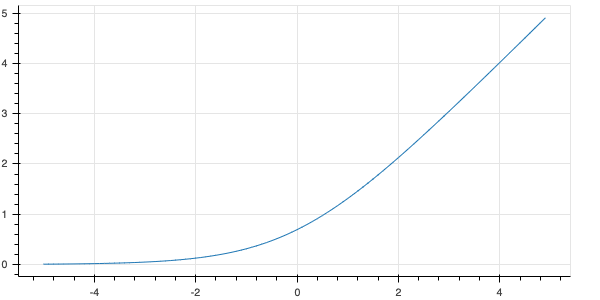
Computes elementwise softplus: softplus(x) = log(exp(x) + 1).
softplus is a smooth approximation of relu. Like relu, softplus always takes on positive values.
<img style=”width:100%” src=”https://www.tensorflow.org/images/softplus.png”>
Example:
>>> import tensorflow as tf
>>> tf.math.softplus(tf.range(0, 2, dtype=tf.float32)).numpy()
array([0.6931472, 1.3132616], dtype=float32)
- Parameters:
features – Tensor
name – Optional: name to associate with this operation.
- Returns:
Tensor
- static default_inverse_activation(x)
Compute the element-wise inverse softplus of the input tensor.
- Parameters:
features (tf.Tensor) – Input tensor containing the values to apply the inverse softplus function.
x (Tensor)
- Returns:
A tensor with the same shape as features.
- Return type:
tf.Tensor
- dirichlet_multinomial_scores(values)
Computes log Dirichlet-multinomial marginals of count vectors.
Scores observed count vectors with the (mixture of) Dirichlet-multinomial marginal(s), i.e. the proper marginal likelihood of the counts with the categorical probabilities integrated out (Sjolander et al. 1996). This is the count-based counterpart of
prior_scores(), which instead scores probability vectors with the Dirichlet density.- Parameters:
values (Tensor) – The observed count vectors of shape
(H, Q, D).- Returns:
- The scores with shape
(H)with Dirichlet-multinomial log marginals for each head summed over the states.
- The scores with shape
- Return type:
Tensor
- classmethod from_config(config, custom_objects=None)
Initializes and returns an object of this class with the given configuration dictionary.
- Parameters:
config (dict[str, Any])
custom_objects (None)
- Return type:
T_Model
- get_config()
Returns the config used in the class as a dictionary.
- Return type:
dict[str, Any]
- get_default_initializer()
The initializer used when none is set explicitly.
- Return type:
Initializer
- property initializer: Initializer
The initializer of the emission matrix.
For a single component, the initializer values are the Dirichlet concentration parameters (all must be > 0). Defaults to ones.
For multiple components, the flat initializer must be resizeable to
(H, Q, P)wherePis the number of distribution parameters per head and state.Let
Dbe the alphabet size andCbe the number of mixture components. The initializer is ordered as follows: - Concentrations of component 1 (Dvalues) - … - Concentrations of componentC(Dvalues) - Mixture coefficients (Cvalues)Defaults to concentration ones and uniform mixture coefficients.
- log_dirichlet_multinomial_pmf(counts)
Compute the log pmf of a Dirichlet-multinomial marginal.
- Parameters:
counts (Tensor) – The observed count vectors of shape
(H, Q, D).- Returns:
- The log pmf with shape
(H, Q)for single component, or
(H, Q, C)for multiple components.
- The log pmf with shape
- Return type:
Tensor
- log_dirichlet_pdf(x)
Compute the log pdf of a Dirichlet distribution.
- Parameters:
x (Tensor) – The input values of shape
(H, Q, D), where the values must sum to 1 along the last dimension.- Returns:
- The log pdf with shape
(H, Q)for single component, or
(H, Q, C)for multiple components.
- The log pdf with shape
- Return type:
Tensor
- matrix()
Calculates a tensor with the parameters of the Dirichlet distributions per head and state.
For multiple components, the matrix contains the concentration parameters of each component as well as the mixture coefficients: (conc component 1, …, conc component C, mixture coefficients)
- Returns:
- The parameter matrix of shape
(H, Q, P)where His the number of heads,Qis the number of hidden states andPis the number of parameters.
- The parameter matrix of shape
- Return type:
Tensor
- property matrix_dim: int
Last dimension of the matrix.
- mean()
Compute the mean of the Dirichlet prior distribution.
For a single component, the mean is
alpha / sum(alpha). For a mixture, the mean is the mixture-weighted average of per-component means:sum_c w_c * alpha_c / sum_d(alpha_c_d).Padding states (where all concentrations are zero) are returned as zeros.
- Returns:
Mean of shape
(H, Q, D).- Return type:
Tensor
- prior_scores(values)
Computes log-Dirichlet densities.
- Parameters:
values (Tensor) – The input values of shape
(H, Q, D), where the values must sum to 1 along the last dimension.- Returns:
- The prior scores with shape
(H)with dirichlet log densities for each head summed over the states.
- The prior scores with shape
- Return type:
Tensor
- class hidten.tf.prior.dirichlet.TFDirichletPriorConfig(*, components=1)
Bases:
ModelConfigThe configuration for a Dirichlet prior.
- Parameters:
components (int)
- components: int
The number of mixture components.
- model_config = {}
Configuration for the model, should be a dictionary conforming to [ConfigDict][pydantic.config.ConfigDict].
- hidten.tf.prior.dirichlet.dirichlet_init_transform(x, input_dim, num_components=1)
Transforms concentration parameters and mixture coefficients to kernel values.
- Parameters:
x (Tensor) – Initializer values with structure: [conc_comp1, …, conc_compC, mix_coef]
input_dim (int) – Dimensionality of the categorical distribution.
num_components (int) – Number of mixture components.
- Returns:
Transformed kernel values with concentrations in inverse-softplus space and mixture coefficients in log space.
- Return type:
Tensor
Algorithms
Core algorithms for inference and learning.
- class hidten.tf.forward_backward.TFForwardBackwardMixin
Bases:
ScannerMixin class for the forward-backward algorithm in TensorFlow. Must not be used otherwise than as a mixin in the TFHMM class.
- backward_log(*observations, transition_delta=None, parallel=1)
Runs the vectorized and differentiable backward algorithm and returns backward log-probabilities.
- Parameters:
observations (Tensor or tuple of Tensors) – The input sequence(s). Tensor i should be broadcastable to shape
(B, T, H, D_i)whereBis the batch size,Tis the time dimension,His the number of HMM heads andD_iis the feature dimension.transition_delta (Tensor or None, optional) – Time-varying change that is added on top of the transitioner kernel. Should be of shape
(B, T-1, K)or broadcastable to it, whereKis the kernel size of transitioner (seetransitioner.kernel.shape).parallel (int, optional) – The parallel factor for the HMM. Defaults to no parallelization.
self (TFHMM)
- Returns:
- The backward log-probabilities for the input
sequence of shape
(B, T, H, Q).
- Return type:
Tensor
- forward_log(*observations, transition_delta=None, parallel=1)
Runs the vectorized and differentiable forward algorithm that calculates logarithmic forward probabilities.
- Parameters:
observations (Tensor or tuple of Tensors) – The input sequence(s). Tensor i should be broadcastable to shape
(B, T, H, D_i)whereBis the batch size,Tis the time dimension,His the number of HMM heads andD_iis the feature dimension.transition_delta (Tensor or None, optional) – Time-varying change that is added on top of the transitioner kernel. Should be of shape
(B, T-1, K)or broadcastable to it, whereKis the kernel size of transitioner (seetransitioner.kernel.shape).parallel (int, optional) – The parallel factor for the HMM. Defaults to no parallelization.
self (TFHMM)
- Returns:
- The forward log-probabilities of
the input sequence of shape
(B, T, H, Q).
- Return type:
Tensor
- forward_scaled(*observations, transition_delta=None, parallel=1)
Runs the scaled variant of the forward algorithm in vectorized and differentiable manner.
- Parameters:
observations (Tensor or tuple of Tensors) – The input sequence(s). Tensor i should be broadcastable to shape
(B, T, H, D_i)whereBis the batch size,Tis the time dimension,His the number of HMM heads andD_iis the feature dimension.transition_delta (Tensor or None, optional) – Time-varying change that is added on top of the transitioner kernel. Should be of shape
(B, T-1, K)or broadcastable to it, whereKis the kernel size of transitioner (seetransitioner.kernel.shape).parallel (int, optional) – The parallel factor for the HMM. Defaults to no parallelization.
self (TFHMM)
- Returns:
- The scaled forward probabilities (not
logarithmic, but summing to one over the last dimension) for the input sequence of shape
(B, T, H, Q)and the scaling factors of shape(B, T, H, 1).
- Return type:
Tuple of tensors
- likelihood_log(*observations, transition_delta=None, parallel=1)
Computes the log-likelihood of the observations using the forward algorithm.
- Parameters:
observations (Tensor or tuple of Tensors) – The input sequence(s). Tensor i should be broadcastable to shape
(B, T, H, D_i)whereBis the batch size,Tis the time dimension,His the number of HMM heads andD_iis the feature dimension.transition_delta (Tensor or None, optional) – Time-varying change that is added on top of the transitioner kernel. Should be of shape
(B, T-1, K)or broadcastable to it, whereKis the kernel size of transitioner (seetransitioner.kernel.shape).parallel (int, optional) – The parallel factor for the HMM. Defaults to no parallelization.
self (TFHMM)
- Returns:
- The log-likelihood of each observation and head of
shape
(B, H, 1).
- Return type:
Tensor
- posterior(*observations, transition_delta=None, normalize=True, parallel=1, return_emission_scores=False)
Runs the vectorized and differentiable forward-backward algorithm and returns the posterior state probabilities. The result is not logarithmic!
- Parameters:
observations (Tensor or tuple of Tensors) – The input sequence(s). Tensor i should be broadcastable to shape
(B, T, H, D_i)whereBis the batch size,Tis the time dimension,His the number of HMM heads andD_iis the feature dimension.transition_delta (Tensor or None, optional) – Time-varying change that is added on top of the transitioner kernel. Should be of shape
(B, T-1, K)or broadcastable to it, whereKis the kernel size of transitioner (seetransitioner.kernel.shape).normalize (bool) – Whether to normalize the posterior. If false, the output will be the naked product of scaled forward and backward probabilities. This can result in posterior values > 1 due to numerical errors.
parallel (int, optional) – The parallel factor for the HMM. Defaults to no parallelization.
return_emission_scores (bool, optional) – Whether to return the emission scores.
self (TFHMM)
- Returns:
- The posterior state probabilities for the input
sequence of shape
(B, T, H, Q), whereQis the maximum number of states in all HMMs.
- Return type:
Tensor
- class hidten.tf.viterbi.TFViterbiMixin
Bases:
ScannerMixin class for the Viterbi algorithm in TensorFlow. Must not be used otherwise than as a mixin in the TFHMM class.
- maximum_expected_accuracy(*observations, transition_delta=None, parallel=1, output_type=tf.int32, invalid_state=-1, validate_state_seqs=True)
For each batch sequence and each head, computes the state sequence X with maximum sum of the posterior probabilities and P(X) > 0.
- Parameters:
observations (Tensor or tuple of Tensors) – The input sequence(s). Tensor i should be broadcastable to shape
(B, T, H, D_i)whereBis the batch size,Tis the time dimension,His the number of HMM heads andD_iis the feature dimension.transition_delta (Tensor or None, optional) – Time-varying change that is added on top of the transitioner kernel. Should be of shape
(B, T, K)or broadcastable to it, whereKis the kernel size of transitioner (seetransitioner.kernel.shape).parallel (int) – The parallel factor for the HMM.
output_type (tf.dtypes.DType) – The type of the output tensor.
invalid_state (int) – Indiates padding and invalid states (e.g., when no possible state sequence exists.)
validate_state_seqs (bool) – If True, the function checks for the edge case when there is no state sequence with non-zero probability.
self (TFHMM)
- Returns:
- The maximum expected accuracy state sequence
for the input sequence of shape
(B, T, H).
- Return type:
Tensor (int)
- viterbi(*observations, transition_delta=None, parallel=1, output_type=tf.int32, return_variables=False, invalid_state=-1, validate_state_seqs=True, scaled=True)
Computes the most likely state sequences for the given observations with the Viterbi algorithm.
The implementation is logarithmic (underflow-safe) and capable of decoding many sequences in parallel on the GPU. Optionally the function can also parallelize over the sequence length at the cost of memory usage (recommended for long sequences and HMMs with few states).
- Parameters:
observations (Tensor or tuple of Tensors) – The input sequence(s). Tensor i should be broadcastable to shape
(B, T, H, D_i)whereBis the batch size,Tis the time dimension,His the number of HMM heads andD_iis the feature dimension.transition_delta (Tensor or None, optional) – Time-varying change that is added on top of the transitioner kernel. Should be of shape
(B, T, K)or broadcastable to it, whereKis the kernel size of transitioner (seetransitioner.kernel.shape).parallel (int) – The parallel factor for the HMM.
output_type (tf.dtypes.DType) – The type of the output tensor.
return_variables (bool) – If True, the function returns additional variables.
invalid_state (int) – Indiates padding and invalid states (e.g., when no possible state sequence exists.)
validate_state_seqs (bool) – If True, the function checks for the edge case when there is no state sequence with non-zero probability.
scaled (bool) – If True, the Viterbi log-probs are scaled by the maximum log-prob at each time step to improve numerical stability. Only affects parallel.
self (TFHMM)
- Returns:
- The most likely state sequence for the input
sequence of shape
(B, T, H). If return_variables is True, the function also returns the Viterbi values of shape(B, T, H, Q).
- Return type:
Tensor (int)
- class hidten.tf.scan.Scanner
Bases:
object
TensorFlow Utilities
TensorFlow-specific utility functions.
- hidten.tf.util.check_probability_activation(activation, method, attr='activation')
Raises
NotImplementedErrorifactivationis notzero_row_softmaxand therefore not guaranteed to produce normalized probabilities along the rightmost axis.- Parameters:
activation (Callable) – The activation to check.
method (str) – Name of the calling method, used in the message.
attr (str, optional) – Name of the property holding the activation. Defaults to “activation”.
- Return type:
None
- hidten.tf.util.clip(x, min_val=None, max_val=None)
Clips the values of x to be between min_val and max_val.
- Parameters:
x (Tensor)
min_val (float | int | None)
max_val (float | int | None)
- Return type:
Tensor
- hidten.tf.util.ensure_array(x)
Ensures that the input is a numpy array.
- Parameters:
x (Tensor | ndarray | list | float | int)
- Return type:
ndarray
- hidten.tf.util.epsilon(x)
Returns a small value to avoid numerical issues depending on the dtype of
x.- Parameters:
x (Tensor | ndarray | list | tuple | float | int)
- Return type:
float
- hidten.tf.util.flat_to_triangular(flat, upper=False)
Creates triangular matrices from flat vectors.
- Parameters:
flat (Tensor) – A tensor representing lower (or upper) triangular elements of shape
(..., M).upper (bool, optional) – Whether the output matrix should be upper or lower triangular. Defaults to lower.
- Returns:
- Tensor with lower (or upper) triangular elements filled
from
flat, with shape(..., N, N)whereN = (-1 + sqrt(1 + 8 * M)) / 2.
- Return type:
Tensor
- Raises:
ValueError – if
xcannot be mapped to a triangular matrix.
- hidten.tf.util.inverse_softplus(x)
Compute the element-wise inverse softplus of the input tensor.
- Parameters:
features (tf.Tensor) – Input tensor containing the values to apply the inverse softplus function.
x (Tensor)
- Returns:
A tensor with the same shape as features.
- Return type:
tf.Tensor
- hidten.tf.util.local_to_global_factors(local_sf, global_almost_scaled, batch_first=False)
Computes the global scaling factors from the local scaling factors. Also computes correction factors that convert a locally scaled tensor to a globally scaled tensor.
- Parameters:
local_sf (Tensor) – The local scaling factors of shape
(H, B, C, Z, 1).global_almost_scaled (Tensor) – The global variables scaled up to the previous step but unscaled for the current step of shape
(H, B, Z).batch_first (bool, optional) – If True, (only)
local_sfis assumed to have shape(B, C, H, Z, 1)instead.
- Returns:
(global_scaled, global_sf, correction)of shapes
((H, B, Q), (H, B, C, 1), (H, B, C, Z))(independent of thebatch_firstargument).
- Return type:
(Tuple of tensors)
- hidten.tf.util.log_to_scaled(log_probs)
Utility function that converts log probabilities to scaled probabilities.
- Parameters:
log_probs (Tensor) – The log probabilities of shape
(B, T, H, Q).- Returns:
- The scaled probabilities of shape
(B, T, H, Q)and the scaling factors of shape(B, T, H, 1)that were used for scaling.
- Return type:
Tuple of Tensors
- hidten.tf.util.log_zero(x)
Returns the maximum value to avoid numerical issues depending on the dtype of
x.- Parameters:
x (Tensor | ndarray | list | tuple | float | int)
- Return type:
float
- hidten.tf.util.logit(x)
Computes the element-wise logit function, which is the inverse to the sigmoid function:
ln(x / (1-x))- Parameters:
x (Tensor | ndarray | list | tuple | float | int)
- Return type:
Tensor
- hidten.tf.util.map_diagonal(x, fn)
Applies a function to the batched diagonals of batched matrices.
- Parameters:
x (Tensor)
fn (Callable)
- Return type:
Tensor
Calculates the number of shared parameters by a given number of indices and shared ranges of those indices.
- Parameters:
indices (ndarray)
share (ndarray | list[int] | None)
- Return type:
int
- hidten.tf.util.np_dtype(x)
Returns the numpy dtype of the input.
- Parameters:
x (Tensor | ndarray | list | tuple | float | int)
- Return type:
dtype
- hidten.tf.util.safe_div(x, y)
Safely divides the first tensor by the second.
- Parameters:
x (Tensor)
y (Tensor)
- Return type:
Tensor
- hidten.tf.util.safe_log(x)
Computes element-wise logarithm with output_i=log_zero_val where x_i=0.
- Parameters:
x (TFTensor) – Input tensor.
- Returns:
- Element-wise logarithm of x, with log_zero_val where x
is 0. Same dtype and shape as x.
- Return type:
TFTensor
- hidten.tf.util.safe_matmul(A, B, transpose_b=False, balance_factor=4, use_balancing=False)
Performs a batched matrix multiplication of A and B. This is functionally equivalent to tf.matmul (except unused arguments), but numerically, this method is guarded against loss of precision in cases where A is very thin, i.e. let A have shape ( …, m, n ) and B have shape ( …, n, p ), then if m is large compared to n (e.g. m=512, n=15), the numerical precision of, e.g., the forward algorithm will suffer compared to the equivalent case of performing multiple smaller, more balanced matrix multiplications.
When both m and n are statically known and m > balance_factor * n, this method will express the multiplication of A and B as multiple smaller multiplications like this: (…, m, n) x (…, n, p) -> (…, c, z, n) x (…, 1, n, p) where b=cz + r with z = balance_factor * n and c and r are chosen appropriately.
Note: Swapping this method with the default tf.matmul makes some tests with small HMMs but large batch sizes fail due to numerical precision issues.
- Parameters:
A (Tensor)
B (Tensor)
transpose_b (bool)
balance_factor (int)
use_balancing (bool)
- Return type:
Tensor
- hidten.tf.util.safe_norm(x)
Safely makes a probability distribution out of x.
- Parameters:
x (Tensor)
- Return type:
Tensor
- hidten.tf.util.scale(values)
Scales the values by their sum over the last dimension and returns the scaled values and the scaling factors.
- Parameters:
values (Tensor) – The values to scale, shape
(..., Q).- Returns:
- The scaled values of shape
(..., Q), where the last dimension sums to one, and the scaling factors of shape
(..., 1)that were used for scaling.
- The scaled values of shape
- Return type:
(tuple of Tensors)
- hidten.tf.util.scaled_to_log(scaled_probs: Tensor, scaling_factors: Tensor, time_axis: int = 1, return_cumsum: bool = False) Tensor
- hidten.tf.util.scaled_to_log(scaled_probs: Tensor, scaling_factors: Tensor, time_axis: int, return_cumsum: bool) Tensor | tuple[Tensor, Tensor]
Utility function that converts scaled probabilities to log-probabilities.
- Parameters:
scaled_probs (Tensor) – The scaled probabilities of shape
(..., T, ..., Q).scaling_factors (Tensor) – The scaling factors of shape
(..., T, ..., 1)that were used for scaling.time_axis (int, optional) – The axis along which the time dimension is located. Defaults to 1.
return_cumsum (bool, optional) – If True, the cumulative sum of the scaling factors is returned as well. Defaults to False.
- Returns:
- The log-probabilities of shape
(..., T, ..., Q). If return_cumsum is True, a tuple of tensors is returned, where the first tensor is the log-probabilities and the second tensor is the cumulative sum of the scaling factors of shape(..., T, ..., 1).
- Return type:
(Tensor or tuple of Tensors)
- hidten.tf.util.setup_initializer(initializer, transform=None, validate_condition=None, validate_msg='')
- Parameters:
initializer (Initializer | Tensor | ndarray | list | float)
transform (Callable | None)
validate_condition (Callable | None)
validate_msg (str)
- Return type:
Initializer
Creates a dense tensor with optional parameter sharing using scatter operations.
- Parameters:
indices (T_TFTensor) – Tensor of shape
(N, 2), dtype int64.values (T_TFTensor) – Tensor of shape
(..., K), dtype float32.shape (T_TFTensor) – Shape of the resulting tensor not including the leading dimensions of
values.share (T_TFTensor, optional) – Tensor of shape
(N, ), dtype int32 or int64. Defaults to no parameter sharing.
- Returns:
- A dense tensor with shared parameters placed at
given indices. The shape is
(..., ) + shape.
- Return type:
T_TFTensor
- hidten.tf.util.tiny(x)
Returns a tiny value to avoid numerical issues depending on the dtype of
x.- Parameters:
x (Tensor | ndarray | list | tuple | float | int)
- Return type:
float
- hidten.tf.util.triangular_to_flat(triag, upper=False)
Creates flat vectors from triangular matrices.
- Parameters:
triag (tensor) – A tensor representing lower (or upper) triangular elements of shape
(..., N, N).upper (bool, optional) – Whether the input matrix should be intepreted as upper or lower triangular. Defaults to lower.
- Returns:
- A batch of vector-shaped tensors representing vectorized
lower (or upper) triangular elements of
triag, with shape(..., M)where ``M = N * (N + 1).
- Return type:
Tensor
- hidten.tf.util.zero(x)
Returns a small value that can be used without trouble in divisions.
- Parameters:
x (Tensor | ndarray | list | tuple | float | int)
- Return type:
float
- hidten.tf.util.zero_row_softmax(x)
Computes a softmax over the rightmost axis but returns a row of zeros when the input row contains only log_zero values.
- Parameters:
x (Tensor)
- Return type:
Tensor